After more than four years, The Random Films is moving to a new home. The rebranded, restructured and refashioned blog will have new features such as First Peeks (trailers of upcoming movies) and TV Series (reviews of favorite television shows). Hope you support the new blog just the same. Please visit:MOVIEcracy
Showing posts with label Foreign Language Film. Show all posts
Showing posts with label Foreign Language Film. Show all posts
The world is not a perfect place to live. For in every
corner, there are lurking menaces. Even in places where supposedly there is
safety, danger is silently waiting. In this 2003 Swedish drama film, Evil (Swedish: Ondskan) takes us into the life of fifteen-year old Erik Ponti and
the evils he faces both in his home and in his school.
The movie is set in 1950s Sweden. Erik (portrayed by Andreas
Wilson) is expelled from his school because of fighting. His mother sends him
to a prestigious boarding school in the hope that Erik turns a new leaf, as
well as for him to escape the beating of his sadistic stepfather. But Erik soon
learns that behind the mask of prestige, the school hides a different form of
evil, something more subtle and grimmer. From being the bully of his previous school,
Erik has now become the prey.
Everyone seeks justice. But when justice is viewed by
different eyes, conflict occurs. With this conflict come pain, fears, and
doubts. In this 2011 Iranian drama film, A
Separation takes us into the lives of an Iranian middle-class couple and
the complications that their separation and an impending case bring in.
A city of love. Economic hardship. Family breakdown.
Brutality. Sex. Healing. Romance. These are some of the elements that make up
the 2012 French-Belgian romantic drama film Rust and Bone (French: De
rouille et d’os).
The movie opens up with 5-year old Sam saying ”I’m hungry”, an analogy
to the general theme of the film which speaks of needs and desires, and the
urge to satisfy them. This speaks of a universal emotion, and instantly, audiences are drawn into this absurd and animalistic, yet haunting and haunting love
story.
It’s February and it’s the love month. What better way to
celebrate this month is to feature some essential movies about love. And most
usually, when one defines love, one is talking about tragedy. These are the
basic elements of the 2012 Danish film A
Royal Affair (En kongelig affære).
The Flowers of War is
a 2011 Chinese historical drama war film directed by Zhang Yimou. Based on Yan
Geling’s novel, “13 Flowers of Nanjing,” the movie is a story of the
heartbreaks and struggles of a group of escapees during the “Rape of Nanking” –
a mass murder and war rape during the Second Sino-Japanese War. Main cast of
the movie consists of Christian Bale, breakout artist Ni Ni, Zhang Xinyi, Tong
Dawei, Atsuro Watabe, Shigeo Kobayashi,
Han Xiting, and Cao Kefan.
Plot. The movie
opens with chaos all over Nanking, China’s capital city during that time. It is
December 1937 and the Japanese Imperial Army is bombing and invading the city.
Desperate civilians are running everywhere, dodging the war bullets and looking
for safety in the torn buildings. Amidst the turmoil, American mortician John
Miller (played by Bale) arrives in Nanking as he is commissioned to bury the
foreign head priest of a convent for Catholic Chinese girls. He meets two of
the girls along the way, and with their guidance, he arrives at the convent
only to discover that the priest’s body was flown away by a bomb.
Himala (“Miracle”) is a Filipino film directed by the late Philippine National Artist Ishmael Bernal in 1982. Written by multi-award winner screenwriter Ricky Lee, the movie is based on a true incident of a teenage girl in Cabra Island in the province of Occidental Mindoro between 1966 and 1967. The movie’s heroine is played by Philippine superstar Nora Aunor whose portrayal of Elsa is considered by most Filipino critics as the best of her career.
The Counterfeiters (German: Die Fälscher) is a 2007 Austrian-German film written and directed by Stefan Ruzowitzky. It stars Karl Markovics, August Diehl and Devid Streisow. It is distributed by Sony Pictures with English subtitles.
Plot. The movie is based on a memoir, entitled “The Devil’s Workshop,” by Adolf Burger, a Jewish Slovak stenographer who was involved on the Operation Bernhard plan. The plan was a secret strategy by the Nazis during the Second World War to flood the economy with fake Bank of England bills. In this way, Great Britain would be destabilized and the Nazi Empire would gain greater control.
The film opens with a rich man arriving in an expensive hotel in Monte Carlo. Later, a French woman he slept with earlier discovers the tattooed numbers on his arm. The man is actually a Nazi concentration camp survivor named Salomon Sorowitsch.
The movie rewinds back to 1936 in the war-torn Berlin. After being caught by police from forging currency and passports, Salomon Sorowitsch is imprisoned in a labor camp and then later to Mauthausen concentration camp. Inside the camp, Salomon uses his skills and paints the guards and their families in exchange for extra food rations.
Consequently, Salomon is transferred to another concentration camp where he is imprisoned with other Jews who have artistic and printing skills. There he learns that they are commissioned to forge British pounds. In return, they are kept with better conditions than other Jewish prisons, with comfortable bunks, a washroom and adequate food.
In the beginning, Salomon finds this as an opportunity for him to escape the brutality for Jews, but his motives are soon complicated by his growing concern for his fellow prisoners. Then he harbors to sabotage the Nazi operation. He tells the authority he can forge the US Dollar, and excited, the Nazis give him the chance. But Salomon and his fellow prisoners delay their task. One day, the camp guards suddenly announce that the printing machines are to be dismantled and shipped away. The counterfeiters fear that they will be killed. But before anything happens, the camps flee as the Red Army arrives. The counterfeiters rise up and, along with the other prisoners of the camp, escape and stand for their freedom.
The movie then switches back to Monte Carlo. Salomon dances with the French woman on the beach and realizes he has been throwing money all this time. However, he can always make money. He laughs.
Review. The Holocaust is a survivor’s tale and with every film dealing with this subject, we see protagonists braving this tragedy in the bloodiest and most heart-breaking means. With Stefan Ruzowitzky’s “The Counterfeiters,” we see the idea of “survival of the fittest” in a different way – very cunning, witty, suspenseful and mildly dramatic.
The movie centers around the life of a Salomon Sorowitsch with Operation Bernhard as the backdrop. Hence, it is not 100% historically accurate for it is only a fictionalized version; but what it lacks in true facts, it compensates for its deep theme of morality and guilt. In the film, the protagonist is faced with the chance of a “better” life in exchange for his service as money forger. As an outlaw, he approaches it not with the principles of a righteous man but with the self-protective instincts of a seasoned criminal.But will his cooperation justify his survival? Is his personal deliverance worth his partnership with the evil?
In the beginning, Salomon sees things for his own good. Sooner, he sees the other prisoners – impoverished, sickly and brutally mistreated. He might be a hardened man, but it is human nature to be soft, compassionate and mindful of others. Will he let that will to survive compete with his moral obligation to help others? Must justice for himself be an injustice for others? Or can he make justice for both parties?
At the end of the movie, we see the present-day Salomon, wealthy and gambling away his riches. He is disgusted with that life, but he simply does not care – he can make money. This part is somewhat funny and ironic. But Salomon is a learned man. Like every learned man, he simply have to laugh about the lessons from the past.
Reception. The Counterfeiters is a huge critical success. It appeared in many critics’ top ten lists of the best films in 2008, including being 4th in Josh Rosenblatt’s list of The Austin Chronicle. It also won the Best Foreign Language Film in the Academy Awards 2007.
Rating. Five stars out of five for this movie. This is a true classic.
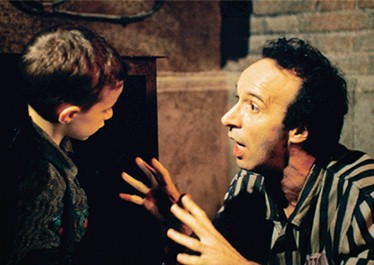
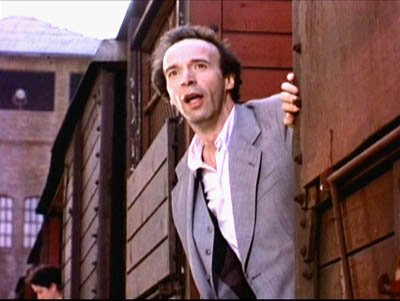
Life is Beautiful, (Italian: La vita è bella), is a 1997 Italian language film. The lead role of the film was played by Roberto Benigni who also co-wrote and directed it. Nicoletta Braschi, Benigni’s actual wife, played the female protagonist in the movie.
Plot. The first half of the film deals with the comic and romantic development of the affair of Italian Jew Guido Orefice and aristocratic Dora, set before the Second World War. The second half is the family’s strife through the War as they struggle to keep the family together.
Before the War, Guido Orefice arrives in Arezzo where he takes a job as a waiter in his uncle’s hotel and plans to set up his own bookstore. Later, he romances a local school teacher named Dora who happens to come from a wealthy, aristocratic, non-Jewish Italian family. On the night of her engagement party from her arrogant fiancé, Guido comes and steals her away. They marry and have a son they named Giosuè.
Years pass and Giosuè has grown to be a good four-a-half-year-old kid. However, World War II has set out and Guido, his uncle, and Giosuè are forced to take a train going to a concentration camp on Giosuè’s birthday. Dora manages to board on the same train.
In the camp, Guido hides his son from the Nazi guards. To keep Giosuè from crying and wanting to go home, he continually humors him. He tells him that the camp is only a game, and the first person to reach 1000 points will get a reward – a tank. Crying and complaining will make them lose points while being a quite boy who successfully hides from the camp guide will earn them points. Meanwhile, Dora stays on the women’s camp but is assured by Guido that they are safe. Despite the loneliness, misery, sickness and death around them, Guido manages to keep his family’s spirits through his humor and optimism.
On their last night in the camp, the American forces advance and take over the camp. In the ensuing chaos, Guido tells his son to stay inside a sweatbox until everybody has left, this being the final test before the tank is rewarded to the winner. After trying to find Dora, Guido gets caught by a Nazi guard and is consequently shot dead. The following morning, Giosuè gets out of the sweatbox and find the camp deserted. An American tank soon arrives and is delighted with the idea that they have won the contest. The Americans take him and on their way, they see his mother and Giosuè gets reunited with her. Years later, Giosuè realizes the sacrifices his father has made for them and that he has died on that night.
Review. Life is Beautiful is personally one of my most favorite films. The movie is wonderfully written, the cinematography is brilliant, the storyline is new, and the message is very deep and inspiring.
The movie is a beautiful mix of comedy and drama. The comedy lies in the light disposition of the main character. His wife falls for him because of him great humor and sincerity, and his son survives the war through his imagination and wit. Throughout the film, he keeps on putting smiles on his family’s face despite the very trying situations. On the other hand, the drama lies in the family’s love for each other and their unselfish desire to keep themselves together. Dora, the wife, follows his family to the camp, unmindful of the dangers she would encounter, though she could avoid it all because she is not Jewish. Giosuè, the son, has faith in his father and is able to maintain his innocence and giggles amidst the gunfire. And of course, Guido, the loving father and husband, does any possible things to remind his family of their happy moments, and to be hopeful that they will all be reunited in the end. His effort to remain positive despite the War is overwhelmingly inspiring.
Life is Beautiful is about the War, family, and life. It is educational as it portrays the hardship that Jews suffered during World War II. Also, it motivates audience to value the bonds of family and to realize the sacrifices parents are willing to do for their children. And lastly, the movie teaches us great lessons about hope, happiness, and love.
Actor. I looked up to Roberto Benigni. He perfectly does comedy, yet also being dramatic at the same time. His character Guido is able to appear genuinely happy before his son, yet anyone can see the tears welling in his eyes and the misery in them. That was really heart-breaking and only a few, brilliant artists can do that. Plus, the language is Italian, yet non-Italians can feel right through the emotions. I take off my hat for him!
Unforgettable scene. The memorable parts of the film will be those heart-breaking scenes, and there lots of them. Even just imagining, my heart still aches for that scene on the fateful night when Guido dies. He is really on a grave danger that moment, but Guido is still able to make Giosuè laugh, even for the last time.
Reception. The film was both financial and critical success. Rotten Tomatoes gave it a “Fresh” rating of 79%. At the 71st Academy Awards in 1999, Benigni won the Academy Award for Best Actor and the film won both the Academy Award for Best Original Dramatic Score and the Academy Award for Best Foreign Language Film. It also won the Grand Prize of the Jury at the 1998 Cannes Film Festival.
Rating. Five stars for this movie! Life is Beautiful has instantly become a classic and would forever remain one of the most celebrated films of all time.
A mother’s love and how much she can do for love is too much to fathom. And one of the best movies dealing with this complexity is this 2006 Spanish film.
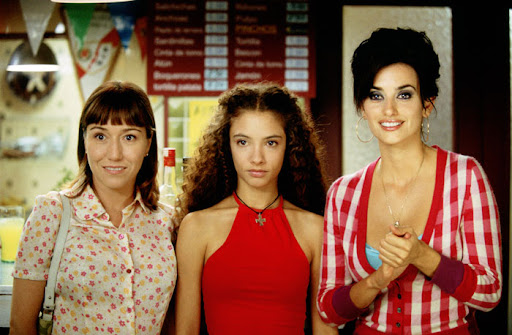
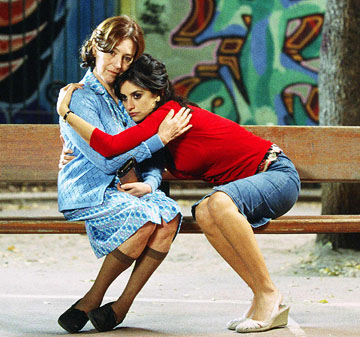
Volver, Spanish for “to come back”, is a film directed by Pedro Almodóvar and stars five outstanding female actresses including Penelope Cruz.
The movie details the intertwined lives of five women – Irene and her daughters Sole and Raimunda, Raimunda’s daughter Paula, and their friend Augustina. Sisters Raimunda (Penelope Cruz) and Sole grew up in a small village in La Mancha but now both live in Madrid. Their parents died in a tragic fire three years earlier. One day, Sole has to return to their village to attend to her aunt’s death. There, she encounters the ghost of their mother Irene, and when she returns to Madrid, the ghost also goes along with her. Sole is frightened but agrees to let her mother stay with her. Meanwhile, Raimunda and her daughter Paula have a different death to cope with. Paula accidentally kills her father when he attempts to rape her. Raimunda quickly hides the corpse in a freezer of a nearby unused restaurant. To keep the secret hidden, she manages to run the restaurant again and deals to cater for different events. Later, Raimunda undertakes the task of disposing her husband’s remains. To accomplish this, Raimunda leaves her daughter Paula to her sister Sole. But this is such a fateful thing to do! Paula sees her grandmother’s ghost and grows close to her. What revelations will be further exposed? What will Paula learn from her grandmother’s ghost? What has really happened in that fire three years before?
Volver has so much themes. According to director Almodóvar, the movie “is precisely about death… More than about death itself, the screenplay talks about the rich culture that surrounds death in the region of La Mancha, where I was born.” There are two deaths in the movie, and how each mother deals and copes with death is quite different. One chooses to stay behind the shadows and waits for the appropriate time to redeem herself, while the other faces death and resolves to make “good” of it. This also deals with two stories between mother and daughter – one is estranged by death and lies, while the other builds itself over loss and secret.
Watching the movie is like reading a Charles Dickens’ book. There are several characters involved, events are sluggish especially at the beginning, and audiences will keep on wondering where the story will lead to. Yet in the end, everything will fall into place, the significance of each character’s role will be highlighted, and the audience will empathize with the emotional turmoil with the characters.
Rotten Tomatoes gave the movie an approval rating of 91%. Volver also appeared in many critics’ top ten lists of the best films of 2006, including critics in the Los Angeles Times, New York Times, Rolling Stone, USA Today, and The Wall Street Journal. It received several wins and nominations including the Academy Awards, Golden Globe Awards, BAFTA Awards, Cesar Awards, Goya Awards, Cannes Film Festival, and many others. Penelope Cruz’s performance in the film was also well-acclaimed and awarded. In the box office, Volver is one of the top-grossing foreign language films of all time.
I will give the film three and a half stars out of five. The film has great storyline but I find it too complex. I have to watch it a second time to fully comprehend its message and only then I appreciated it. Also, the first half of the film is quite slow and the fact that audiences has so few ideas where the story goes may discourage them from watching the movie until the end. However, it is hard to discredit what many critics have to say about the film so I will still say it is a meaningful and worthy film.
.jpg)